At some point most growing businesses in the UAE hit the same wall. The tools that got you here start forcing workarounds. Your team keeps a spreadsheet next to the CRM because the CRM cannot hold what you actually need. Two departments pay for overlapping subscriptions. Someone asks the obvious question: should we just build our own software?
Most answers to that question come from someone with something to sell, either licences or development hours. This article gives you the decision framework we use with our own clients, including the cases where we advise against building.
What each option really costs
Off-the-shelf software looks cheaper because the price is visible: a monthly fee per user. The hidden costs sit elsewhere. Subscriptions multiply across teams and years. Workarounds consume staff hours daily. Features you need do not exist, and features you pay for go unused. As headcount grows, per-seat pricing grows with it, forever.
Custom software reverses the shape of the cost. The investment is concentrated up front and visible, which makes it feel expensive. But there are no per-seat fees, no forced upgrades and no paying for modules you never open. Over a horizon of several years, businesses running core operations on custom systems often spend less in total, and own an asset instead of renting one.
Neither shape is automatically better. The question is which shape fits your situation.
When off-the-shelf genuinely wins
- The problem is standard. Accounting, email, document storage and payroll are solved problems. Building your own version of these adds cost without advantage.
- You need it running this month. Off-the-shelf deploys in days. If speed matters more than fit, buy.
- Your process is still changing weekly. Early-stage businesses should not freeze an unfinished process into code. Rent tools until the process stabilises.
- A good-enough fit really is good enough. If a tool covers ninety percent of what you need and the missing ten percent is minor, the maths rarely favours building.
When custom software wins
- Your process is your advantage. If you win business because you operate differently, generic software actively erodes the thing that makes you win.
- Workarounds have become the process. When spreadsheets, manual re-entry and duct-tape integrations hold your operation together, you are already paying custom-software money in staff time.
- Your systems refuse to talk to each other. Integration is where off-the-shelf stacks quietly fail. A custom layer that connects your existing tools is often the highest-return build of all.
- Per-seat pricing is punishing growth. If every new hire adds licence cost across five tools, ownership starts beating rental quickly.
- You need bilingual or region-specific behaviour. UAE businesses often need Arabic and English interfaces and local compliance handling that global products treat as an afterthought.
The middle path most companies miss
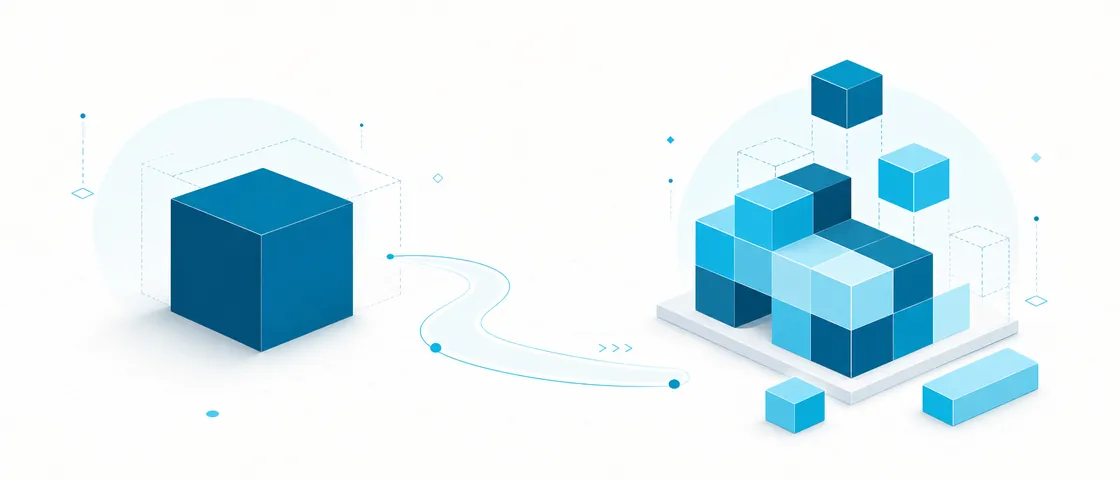
The choice is rarely all or nothing. The pattern we implement most often for UAE clients is a hybrid: keep the solved problems on off-the-shelf tools, and build custom only where your business is genuinely different. A custom operations core that integrates with standard accounting and email delivers most of the benefit at a fraction of the cost of replacing everything.
Automation belongs in this conversation too. Sometimes the answer is not new software at all but an automation layer that removes the manual work between the tools you already own. We covered where that applies in our guide to AI automation for business.
Questions to ask before you build
- Which parts of our operation are genuinely unique, and which are standard?
- What are our current tools costing per year, including the hours lost to workarounds?
- Will we own the source code outright, with documentation, if we build?
- Who maintains the system after launch, and what does that cost?
- Can we start with one module and expand, rather than a big-bang replacement?
That last question matters most. The lowest-risk path into custom software is a focused first build that solves one painful process, proves its value and earns the next phase. It is exactly how we structure custom software projects for clients in Abu Dhabi and across the UAE.