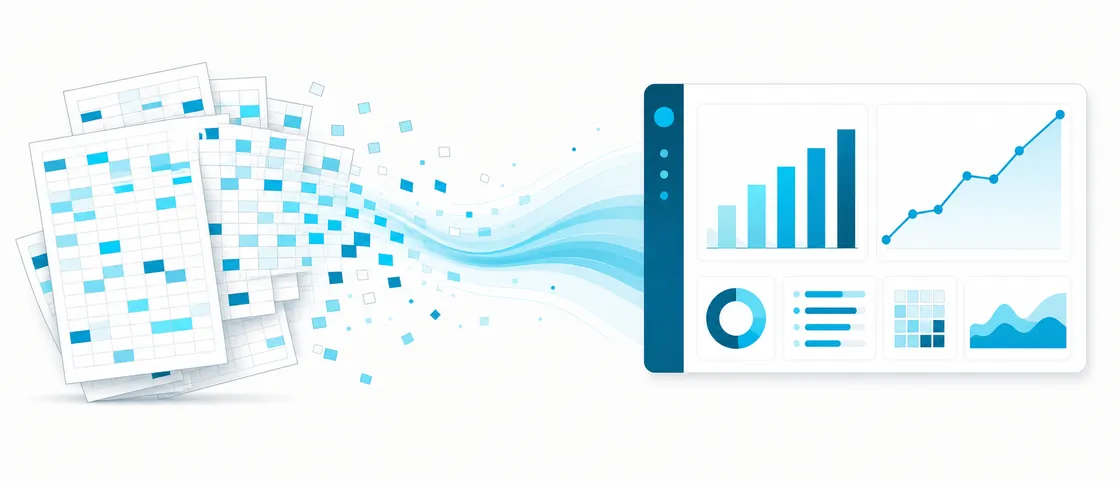
No one decides to run a company on spreadsheets. It happens gradually. A quick price list becomes the pricing system. A leave tracker becomes the HR record. A copy of a copy of the sales pipeline becomes the version everyone argues about in Monday's meeting. Spreadsheets are brilliant tools, which is exactly why they quietly become infrastructure.
The problem is not the spreadsheet. It is the moment the business outgrows it and nobody notices, because everything still mostly works. This article covers the warning signs, what they cost, and the practical path out.
The warning signs
- Version confusion. Files named final, final2 and FINAL-USE-THIS. Two managers present different numbers for the same metric because they opened different copies.
- One person is the system. A single employee understands the formulas. When they are on leave, reporting stops. When they resign, the business loses institutional memory it never knew it had.
- Re-typing as a job description. Staff copy data between the accounting tool, the spreadsheet and the email thread. Every manual hop is paid time and a fresh chance for an error.
- Monday numbers arrive on Wednesday. Reports take days to assemble, so decisions run on last week's picture of the business.
- Silent errors with real costs. A dragged formula, a sorted column that detached from its neighbours, a stale link. Spreadsheet mistakes do not announce themselves; they surface later as wrong prices, missed invoices and unhappy customers.
- Everyone can see everything. Spreadsheets have no meaningful access control. Salary data, customer lists and margins travel in email attachments with no record of who has copies.
Why businesses stay stuck
Everyone senses the problem long before anyone acts, and the reasons are understandable. The spreadsheet still works, mostly. Nobody has time to migrate. Proper software sounds expensive. And the person who built the spreadsheet maze is often proud of it, with reason, because it carried the company this far.
But the costs are already being paid, invisibly: hours of manual assembly, decisions delayed by stale numbers, errors caught late and growth constrained by processes that cannot scale. The move to real systems does not create new cost. It makes an existing cost visible and then removes it.
The path out, in the right order
Step 1: Map what the spreadsheets actually do
List every spreadsheet the business depends on and what job each performs: record keeping, calculation, reporting, workflow tracking. This map is the requirements document for everything that follows, and it usually reveals that a handful of files run half the company.
Step 2: Give data one home
The version problem disappears when numbers live in one governed place instead of twenty files. A properly built data platform pulls from your accounting system, sales tools and operations into a single source of truth, with access controls deciding who sees what. This is the core of our data and analytics work for UAE businesses.
Step 3: Let reports build themselves
Once data has one home, dashboards and scheduled reports replace manual assembly. The Monday numbers exist on Monday morning, accurate and untouched by human copy-paste. Managers stop compiling and start deciding.
Step 4: Replace workflow spreadsheets with real tools
Spreadsheets tracking approvals, jobs and handovers are workflow systems wearing a disguise. Purpose-built internal tools carry the workflow properly: statuses, permissions, history and automatic notifications. Where a process is unique to your business, a focused piece of custom software fits better than any generic product. We wrote about making that build-versus-buy call in our guide to custom versus off-the-shelf software.
Step 5: Keep spreadsheets for what they are good at
The goal is not a spreadsheet-free company. Ad hoc analysis and quick modelling belong in spreadsheets. Systems of record do not. The dividing line: if the business would suffer when a file breaks or its owner leaves, it belongs in a system.
Start smaller than you think
The migration fails when attempted as one giant project. It succeeds as a sequence: pick the spreadsheet causing the most pain, replace that one job properly, let the result argue for the next step. Most of our Abu Dhabi clients see the first dashboard or tool live within weeks, which is usually the moment the rest of the roadmap stops needing persuasion.