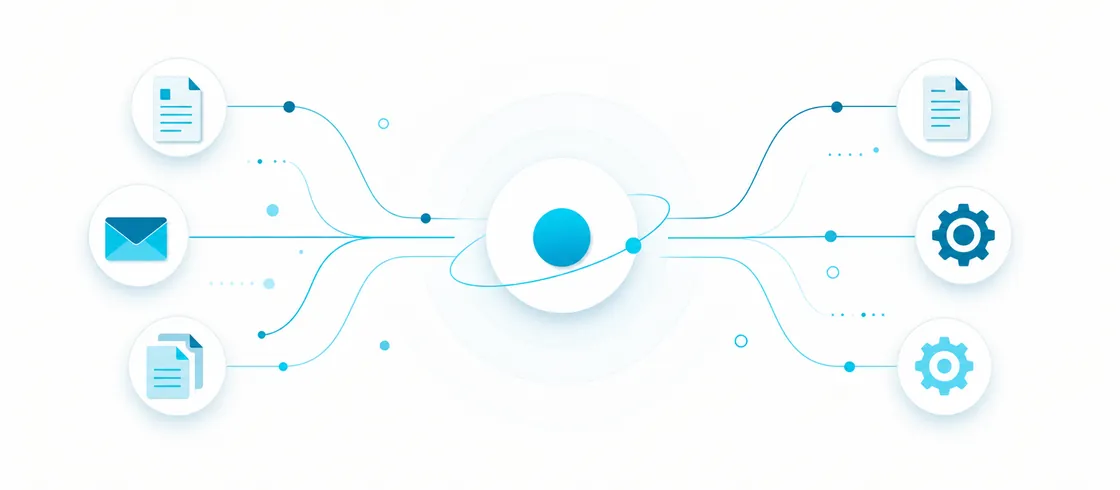
There is a lot of noise around AI, and most of it is unhelpful for a business owner trying to decide what to actually do. The truthful starting point is this: the biggest near-term value of AI for most companies is not a futuristic product. It is removing the repetitive work that fills the week of every team, the copying, triaging, chasing and re-typing that nobody was hired to do.
This article looks at where AI automation reliably works today, what the pieces are, and how to begin without disrupting operations.
The work that should not need a human
Walk through a typical office week and you will find the same patterns everywhere:
- Reading emails and deciding who should handle them.
- Copying information from invoices, forms and IDs into systems.
- Answering the same twenty customer questions in slightly different words.
- Assembling the same weekly report from the same three sources.
- Chasing approvals and reminding people about pending steps.
- Re-entering data from one tool into another because they do not talk to each other.
Each item looks small. Together they consume a large share of payroll and, more importantly, they delay everything downstream: quotes go out later, customers wait longer, decisions sit in inboxes. These high-volume, rule-based tasks are exactly what current AI handles well.
The building blocks, in plain terms
AI assistants and chatbots
Modern assistants are trained on your own documents, policies and product information, so they answer in your voice with your facts. Deployed on a website or internally, they resolve the routine majority of questions instantly and pass the genuinely difficult ones to a person, with context attached. For businesses serving the UAE market, they can operate in both English and Arabic.
Document processing
AI can now read invoices, contracts and forms, including scans, extract the fields that matter, validate them against your records and file the results. What changes is not just the hours saved but the error rate: automated extraction does not mistype numbers at the end of a long day.
Workflow automation
This is the connective layer: when an enquiry arrives, qualify it, create the CRM record, notify the right person, send the acknowledgement. Multi-step processes that used to depend on someone remembering now execute the same way every time, with a log of everything that happened.
AI agents
Agents combine the pieces above and act with a degree of autonomy inside limits you define: a sales agent that scores and routes leads, an operations agent that keeps routine tasks moving, a research agent that assembles briefings. The important design principle is human-in-the-loop: sensitive decisions escalate to people, while the labour happens automatically. We cover this layer in depth on our AI and automation service page.
How to start without breaking things
The failed AI projects we see usually share one mistake: they started too big. The pattern that works is almost boring:
- Map the repetitive work. List the tasks that are high-volume and rule-based. Ask each team what they do every single week that feels mechanical.
- Rank by return. Estimate hours consumed and error cost for each candidate. One or two will stand out.
- Automate one workflow first. Prove it end to end: measure the hours before, deploy, measure after.
- Keep people in control. Design escalation paths from day one so the automation earns trust instead of demanding it.
- Expand from evidence. Once the first workflow pays, the next candidates are already ranked.
The questions to settle before you build
- Data boundaries. Where does your business data go, who can access it, and is it used to train anyone else's models? Insist on clear answers. Private deployment options exist for sensitive workloads.
- Failure behaviour. What happens when the AI is unsure? The right answer is escalation to a person, never a confident guess.
- Measurement. Agree the baseline before the build, so results are checked against reality rather than claimed afterwards.
- Data readiness. Automation is only as good as the data underneath it. Cleaning and connecting your sources is often the real first step, which is why automation work pairs naturally with data and analytics.
What this means in practice
Teams that automate their repetitive work do not usually shrink. They redirect the recovered hours into the work that grows the business: talking to customers, improving the product, closing deals. The companies that benefit most are rarely the ones with the biggest budgets. They are the ones that started with one well-chosen workflow and let the results argue for the next one.