A quote for a mobile app is only as honest as the brief behind it. It is common, in Abu Dhabi and across the UAE, to receive three proposals for what the client believes is the same app, with numbers that are not in the same range. The apps in those proposals are not the same. One assumes a simple catalogue. Another assumes payments, roles and an admin desk. The third assumes a product that has to talk to a system you already run.
That gap is a scope problem, not a mystery of the market. If you want quotes you can compare, write the scope before you ask for the number.
Start with the job, not the feature list
The most useful sentence in a brief is not a list of screens. It is the job the app has to do for a specific person. A clinic may need patients to book, move an appointment and pay a deposit without calling reception. A distributor may need a driver to confirm a delivery and capture a photo when nobody is there to sign. A membership business may need people to see what they are entitled to, and nothing else.
Write that job in one paragraph. Then write who is stuck if the app is late, confusing or wrong. If you cannot name the person and the job, you are not ready for a quote. You are ready for a discovery conversation, and a careful studio will say so.
Decide who version one is actually for
Apps stall when version one tries to serve every audience on day one. Customers, staff, partners, and a manager who wants a dashboard. Each audience adds screens, permissions and awkward cases. Each awkward case adds time.
Pick one primary user for the first release. Write the five things they must be able to finish without help. Everything else is a later version. This is not a lack of ambition. It is how you learn whether the idea is worth the rest of the build. A studio that urges you to include every idea in version one is protecting a larger invoice, not your launch.
Choose the shape of the product
You have three honest options.
A native app for iPhone, a native app for Android, or both. This is the right call when you need the camera in a demanding way, reliable offline use, or the feel of the platform itself. It costs more because you are building two products, or paying for two specialist paths.
A cross platform app, built once and shipped to both stores. This is the right call for most business apps we see discussed in the UAE: bookings, catalogues, field tools, customer portals. You give up a little platform polish and keep one codebase that can be improved without doubling every change.
A web app people open in the browser, with the option to save it to the home screen. This is often enough when the work is occasional, users are on a mix of devices, and you do not need the app stores. It is also the fastest way to learn whether people will use the thing at all.
Say which of these you want, and why. If you do not know, say that. A useful proposal recommends one and explains the compromise. It does not hide the choice inside a single price.
List the flows, not the buttons
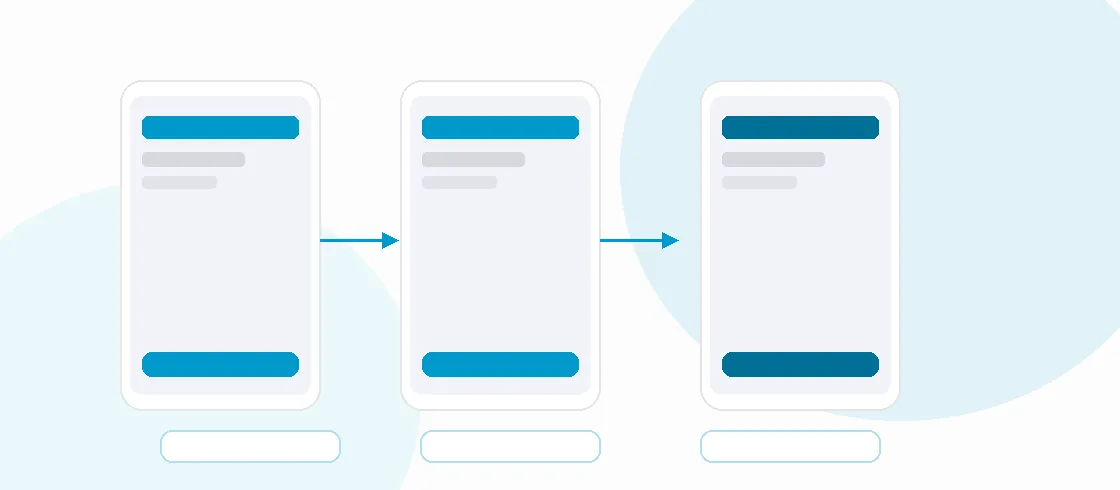
A screen count is a weak scope. A flow is a strong one. A flow is a person starting with a need and ending with a result. Book an appointment. Reset a password. Approve a request. Download a statement.
For each flow, note what the person sees first, what they must enter, what the system checks, what happens when something is missing or wrong, and what they receive at the end, on screen and by email or message.
Five clear flows will produce a better quote than thirty vague screens. They also give your future team something to test against. If a flow cannot be completed, the app is not done, regardless of how many pages exist.
Name the systems the app has to touch
This is where projects quietly grow. The app looks simple until someone says it must create the customer in the accounts tool, take payment through a local gateway, and send the receipt on WhatsApp. None of that is unreasonable. All of it is work, and none of it should appear for the first time after you have signed.
Write a short list. Payments. Maps. SMS or WhatsApp. Your website login. Your stock system. Your customer records. For each one, say whether it already exists and who controls the account. If a vendor has to grant access, start that conversation before development, not during it. Waiting on a third party is one of the most common reasons a build slips, and it is rarely solved by working longer hours.
Data deserves its own line. What will you store about a person, where will it live, and who is allowed to see it? You do not need a legal essay in the scope. You do need to say whether the app holds identity documents, health information, payment details, or only a name and a phone number. That choice changes accounts, logs and backups.
Ask for a quote you can read
A proposal you can compare has the same parts every time. What version one includes, written as flows. What is explicitly left out. Which platforms. How design is handled, and whether you will see it before a long build. How you will review progress. What you receive at the end: source code, store accounts, design files, documentation. What happens after launch. What you must provide, and by when.
Be wary of a single number with no boundary. Be equally wary of a price table you found online. Published ranges for app work in the region vary so widely that they describe someone else's assumptions, not your flows. Your number should describe your flows. If a proposal cannot list what is out of scope, the number is a guess.
Questions worth asking any studio
- Who will we actually meet after the sale?
- Will we see a working build before the project is half done?
- How do you handle a change once the scope is agreed?
- Do you submit the app to the stores, or is that left with us?
- What does the first month after launch look like, and what does it cost?
If the answers are vague, the quote is not ready, even if the price looks attractive.
A clear scope does not remove judgement from the build. It gives that judgement somewhere to stand. If you want help turning a rough idea into something a studio can price, our mobile app development team in Abu Dhabi can do that before anyone writes code. Many of those projects also need product design so the flows are tried on a phone, not only described in a document, and some grow into custom software when the app has to share data with the rest of the business. Start with the job the app must do. The feature list can wait.
Questions we hear
Should we build for iPhone and Android at the same time?
Only if both audiences are real in version one. Many businesses in the UAE are better served by a single cross platform build, or by proving the idea as a web app first. The right answer depends on the job, not on a default.
Can a studio quote without a written scope?
They can give a range. They cannot give a number you should sign. If the proposal does not list what is included and what is not, the number is a guess wearing a confident face.
Do we need design before development?
You need the flows agreed, and you should see the main screens before a long build. Design is how you find the awkward steps while they are still cheap to change.